What Is Altitude Sickness?
Altitude sickness is what happens when your body doesn't get enough time to adjust to lower oxygen availability at high elevations. It's one of the most common — and most underestimated — hazards in high-altitude travel. It can affect anyone, regardless of age, fitness level, or previous experience at altitude.
What Causes Altitude Sickness?
The air at high elevations contains the same percentage of oxygen as at sea level (about 21%), but the atmospheric pressure is lower. That reduced pressure means each breath delivers less oxygen to your lungs and bloodstream. The higher you go, the more pronounced this effect becomes.
Your body can adapt to lower oxygen levels, but it needs time. When you ascend too quickly — especially above 8,000 feet (2,438 m) — your body hasn't had a chance to make those adjustments. The result is altitude sickness.
Who Gets Altitude Sickness?
Almost anyone can get altitude sickness. It is not a reflection of physical fitness or overall health. Elite athletes get it. Experienced mountaineers get it. People who had no trouble at altitude on a previous trip can get it on the next one.
The main risk factors are:
- How fast you ascend — the single biggest factor
- How high you go — risk increases significantly above 8,000 ft (2,438 m)
- Where you're coming from — the greater the elevation change, the higher the risk
- Individual physiology — some people are simply more susceptible than others
- Prior altitude sickness — a history of AMS increases your likelihood of experiencing it again
The Three Types of Altitude Sickness
Acute Mountain Sickness (AMS)
The most common form. AMS is what most travelers mean when they say they have altitude sickness. It typically sets in within 6 to 24 hours of arriving at a high-altitude destination and ranges from mild to moderately debilitating.
High Altitude Cerebral Edema (HACE)
A severe and potentially life-threatening progression of AMS in which fluid accumulates in the brain. HACE is rare but serious. It requires immediate descent and emergency medical treatment.
High Altitude Pulmonary Edema (HAPE)
A severe condition in which fluid accumulates in the lungs, impairing breathing. HAPE is the leading cause of death from altitude sickness. Like HACE, it requires immediate descent and emergency care.
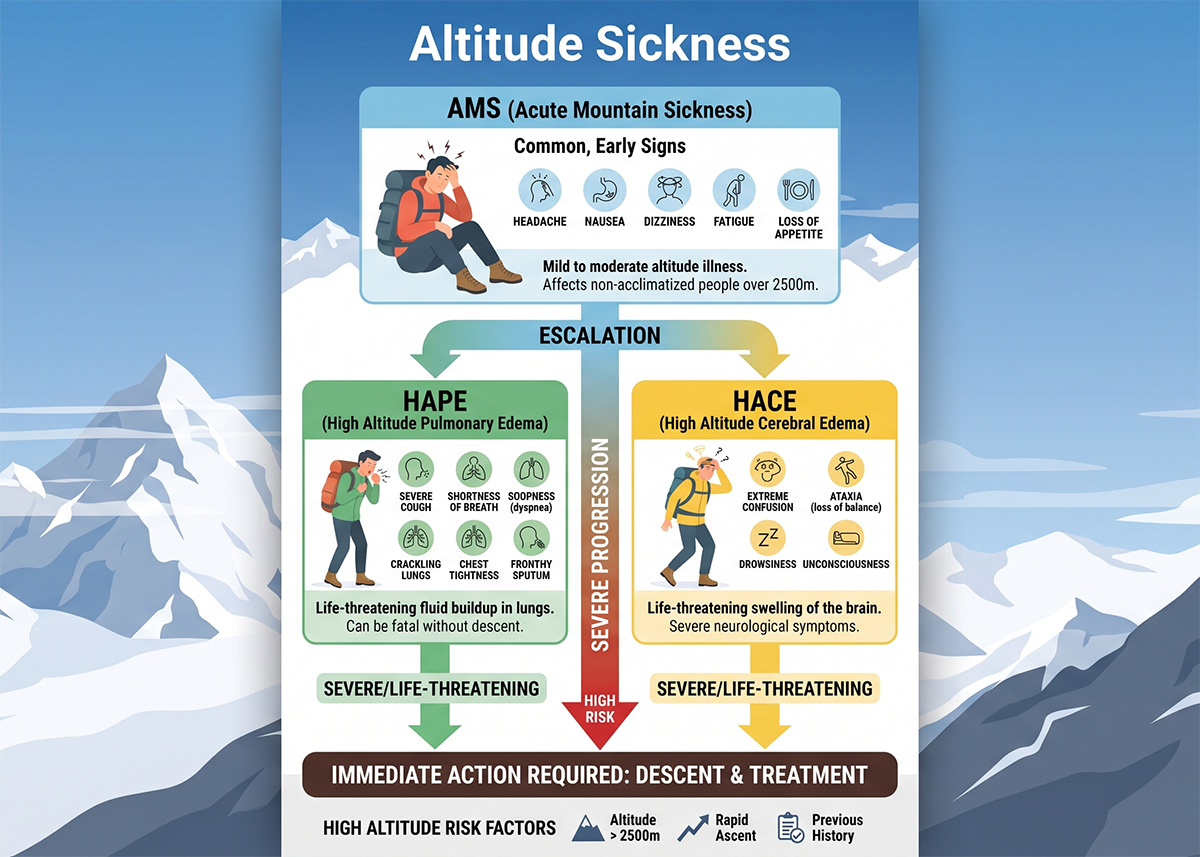
Most travelers will only ever encounter AMS. HACE and HAPE are uncommon, but knowing their warning signs can be life-saving.
Symptoms of Altitude Sickness
Acute Mountain Sickness (AMS)
The hallmark symptom of AMS is a headache at altitude combined with one or more of the following:
- Fatigue or weakness
- Dizziness or lightheadedness
- Nausea or vomiting
- Loss of appetite
- Difficulty sleeping
- Shortness of breath during exertion
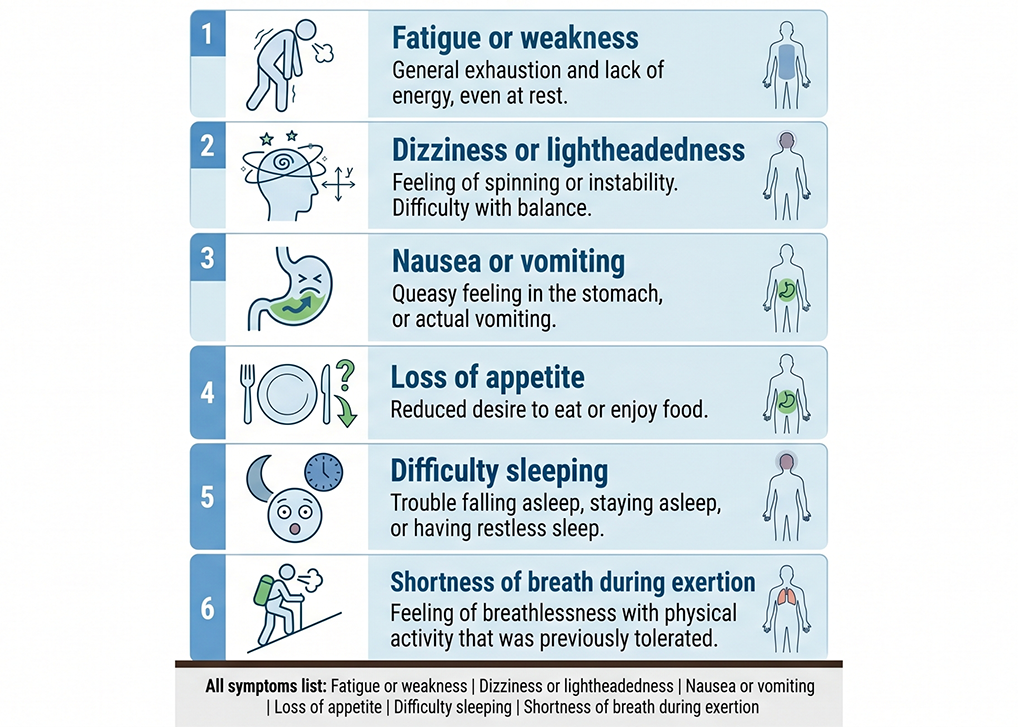
Symptoms typically appear within hours of arrival and often feel worse at night. Mild AMS is unpleasant but not dangerous — most people improve within one to two days if they stop ascending and rest.
High Altitude Cerebral Edema (HACE)
HACE symptoms represent a significant worsening from AMS and include:
- Severe, persistent headache that doesn't respond to pain medication
- Loss of coordination or difficulty walking in a straight line (ataxia)
- Confusion, disorientation, or unusual behavior
- Extreme fatigue and drowsiness
- Loss of consciousness in severe cases
If someone at altitude shows signs of confusion or can't walk a straight line, treat it as an emergency.
High Altitude Pulmonary Edema (HAPE)
HAPE can develop with or without prior AMS symptoms. Warning signs include:
- Breathlessness at rest (not just during exertion)
- A persistent dry cough, which may progress to producing pink or frothy mucus
- A gurgling or crackling sound when breathing
- Extreme fatigue
- Cyanosis — a bluish tint to the lips or fingertips indicating low blood oxygen
HAPE can deteriorate rapidly. Descent should begin immediately and should not wait until morning.
At What Elevation Does Altitude Sickness Start?
Symptoms can begin as low as 8,000 feet (2,438 m), though most people don't experience significant problems until above 10,000 feet (3,048 m). Above 12,000 feet (3,658 m), the majority of unacclimatized travelers will experience at least mild symptoms.
Some of the world's most popular travel destinations sit well within this range:
| City | Elevation | AMS Risk |
|---|---|---|
| Mexico City, Mexico | 7,349 ft (2,240 m) | Low to moderate |
| Bogotá, Colombia | 8,661 ft (2,640 m) | Moderate |
| Quito, Ecuador | 9,350 ft (2,850 m) | Moderate to high |
| Cusco, Peru | 11,152 ft (3,399 m) | High |
| La Paz, Bolivia | 11,942 ft (3,640 m) | High |
| Lhasa, Tibet | 11,995 ft (3,656 m) | High |
Traveling to a high-altitude destination? Use our free altitude comparison tool to see exactly how much elevation you'll be gaining from your home city.